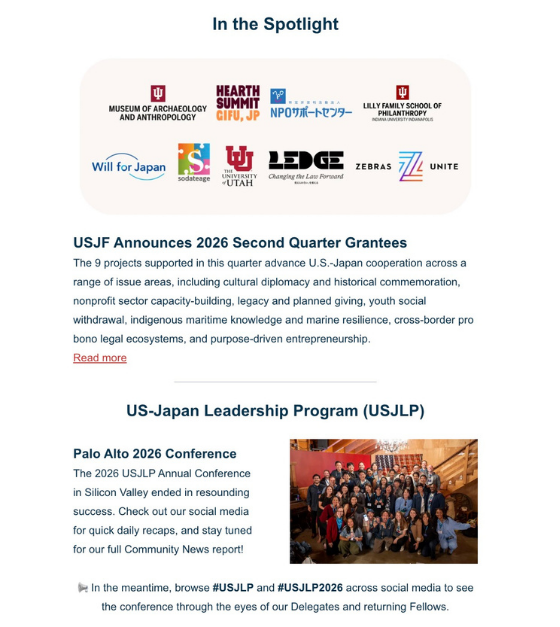
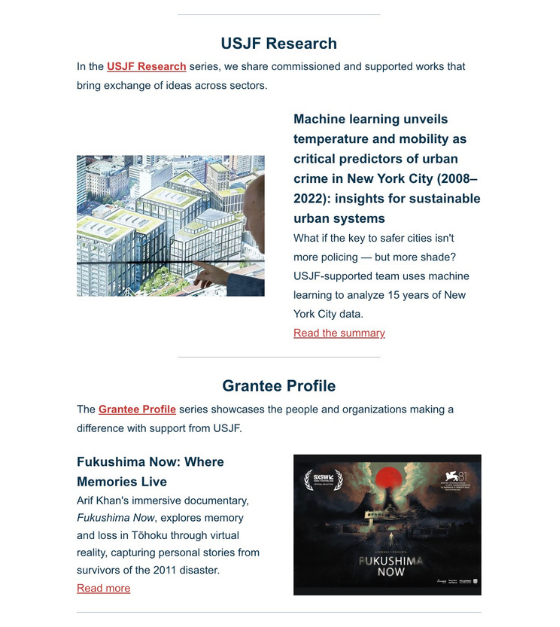
Fukushima Now: Where Memories Live
July 2, 2026

Grantee | Arif Khan (Awarded in April 2021)
 In 2019, Arif Khan boarded a bus from Tokyo heading north. It was his first trip to Japan. Along the route, the bus began threading through the coastal towns of the Tōhoku region, an area devastated by the 2011 earthquake, tsunami, and subsequent nuclear disaster, past shuttered storefronts, overgrown lots, and buildings still frozen in the posture of evacuation. He had no camera. He had no contacts in the region. At that time, a question confronted him: what had happened to this place, to the people who had lived in it, and how does memory function in a situation like this?
That bus ride planted the seed of Fukushima Now, a virtual reality documentary that would go on to premiere at the 81st Venice International Film Festival and travel to festivals across Asia, Europe, and North America. He is planning the Japan premiere now.
Building the Vision
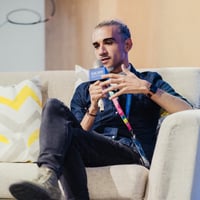 Khan came to the project with an unusual formation. He had earned a Master's Degree in Creative Writing from the University of Cambridge before pursuing an MFA in Film Production at USC's School of Cinematic Arts — moving, as he puts it, from learning how to write scripts to learning how to make them real. After graduating from USC, he joined Oculus Story Studio, Facebook's Emmy Award-winning VR team, then moved to Airbnb Creative Studio, where he produced immersive travel content, before working at Wevr on a VR project led by producer Jon Favreau. By the time the Fukushima idea began to crystallize, he had spent nearly a decade learning what virtual reality could do that traditional film could not: put an audience somewhere, fully and physically, in a way that no screen could replicate.
The question that preoccupied him during the COVID lockdown, when he finally had time to develop the concept seriously, was whether that capacity could serve a human story. It would not be a game or branded content, but something about memory and loss and the meaning of home.
The Grant That Made It Possible
Khan applied for a Fulbright Creative Arts Fellowship and approached the United States-Japan Foundation (USJF) while still in the U.S., before he had set foot in Fukushima as a filmmaker. USJF's support came in early, before production began, and it functioned as the financial backbone of the project: funding the research trips to the region, the high-end photogrammetry equipment used to scan locations, the post-production development in Unity, and the sound design and original score that gave the final experience its emotional texture. "The USJF money essentially allowed us to really build the entire project," Khan explains.
He arrived in Japan in 2022 on the Fulbright fellowship, with USJF support in place and a clear sense of what he needed to do first, which was, deliberately, very little. No cameras. No interviews. Just enough time to meet people and learn from them.
The Outsider as Instrument
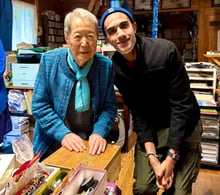 Fukushima had been extensively documented by the time Khan arrived. For more than a decade, journalists, photographers, and filmmakers had cycled through the region, and local communities had grown wary of outsiders arriving to harvest their stories and disappear. Khan was aware of this dynamic and made a deliberate decision: he would spend the first six months simply getting to know people, with no production agenda.
His entry point was two local photographers, Yuki Iwanami and Noriko Takasugi, who had deep roots in the region and opened doors that would otherwise have stayed closed. Through their introductions, Khan met farmers, priests, journalists, and families: the people who would eventually become the eight subjects of Fukushima Now (one of whom, Tomiko Muto, is pictured with Khan). What he discovered, perhaps counterintuitively, was that his outsider perspective was an asset rather than a liability. Because he came without prior context, he asked the questions that those closer to “311” had stopped asking: what life had looked like before the disaster, about childhood and memory and the texture of ordinary days. Those questions, he found, unlocked something in the people he met. “A lot of people seem to think of Tohoku only from 2011 onward, but there were memories before March 11th.”
Memory as Place
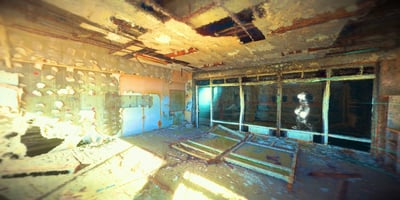 The editorial decision that defines Fukushima Now was to organize the project about memories, both as individual memories and about the process of how memory works. Memory, as Khan conceived it for VR, is a location: somewhere you can go, a place with dimensions and atmosphere and a particular quality of light that a person carries with them from a moment now gone.
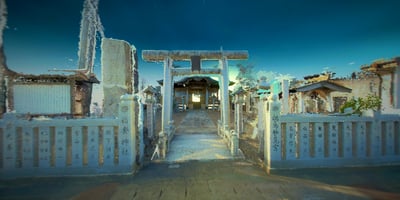
To build those locations, Khan and his technical director, Ruben Frosali, used a process called photogrammetry: thousands of high-resolution photographs taken of Fukushima sites — a coastal elementary school left exactly as it was on the day of evacuation, a centuries-old shrine — fed into software that reconstructs them as fully navigable three-dimensional environments. Audiences who put on a headset are not watching footage of these places, but standing inside them, moving through them, while the voices of the people who remember them are heard in 3D spatialized sound. Some areas of each environment are rendered in sharp detail; others fade into abstraction. “In our memories, there are certain things that are a bit more opaque, that don't have renderings. It's how we remember our lives,” Khan says. It is, as he describes it, the one thing a traditional documentary cannot do: put you inside someone else's past.
Venice Premiere and What Came After
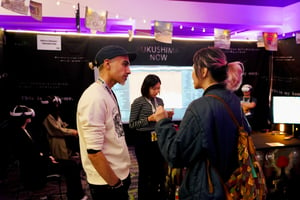 Fukushima Now premiered in 2024 at the 81st Venice International Film Festival to a strong reception, then traveled to the Kaohsiung Film Festival in Taiwan, SXSW in Austin, the Osaka Expo, and festivals across Europe. For Khan, among the most meaningful moments came not on the festival circuit but when he was able to show the finished experience to the people whose memories it contained. They could not have imagined, he says, what it would feel like to step back inside a place they had lost. Several described it as something they could share with their children and grandchildren, a way of preserving what would otherwise fade, a sort of time capsule for future generations to experience. “That was the ultimate goal: that I could make something that I could give back to them, that they could keep with them forever.”
Khan now splits his time between Tokyo and Osaka, where he serves as Creative Experience Director at Universal Studios Japan. A follow-up project is in early development, using the same photogrammetry technology to explore a different community living under a different nuclear shadow: the Tao people of Orchid Island, off the coast of Taiwan, whose indigenous land has stored nuclear waste for four decades. The geography changes, but the question at the center of the work does not — where do memories live? Where do memories die? And what do we owe the places that are no longer with us?
Watch the trailer for Fukushima Now below.