Back to Community News
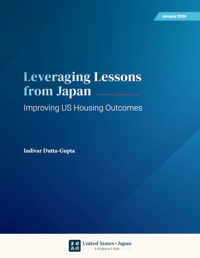 The United States-Japan Foundation (USJF) has published a new paper by Indivar Dutta-Gupta, titled “Leveraging Lessons from Japan: Improving US Housing Outcomes,” exploring how the United States can adapt Japan’s successful housing and social policies to address its own deepening crisis of affordability and homelessness. Read the report here.
Dutta-Gupta’s working paper highlights the stark contrast between the two nations: while housing affordability in the United States has reached record lows—driving a historic rise in homelessness—Japan has achieved some of the best housing outcomes in the developed world. The report argues that Japan serves as a critical "proof point" that high-density urban environments can remain affordable through a combination of flexible zoning, centralized building standards, and robust tenant protections. Dutta-Gupta outlines specific, adaptable lessons for US policymakers, including simplified land-use policies, incentives for individual rental investment, and the automation of public benefit eligibility. A framing essay outlining the conversations and policy debates that informed the paper’s development is also available.
“Fundamentally, Japan represents a key proof point for the possibility of achieving housing affordability in US cities and states through policies supporting significant private housing supply alongside strong tenant protections,” noted Dutta-Gupta. “I wrote this paper to translate Japan’s experience into practical, adaptable strategies that can inform the pressing affordability and homelessness challenges faced by working and middle-class families in the US, especially renters and low-income households in metropolitan areas. Japanese insights and experiences can shape the evolving housing debate in the United States to create more equitable, liveable, and resilient communities.”
Indivar Dutta-Gupta is a policy expert and political advisor whose consulting firm, Blue Lotus Strategies, works to advance equity and prosperity. A US-Japan Leadership Program (USJLP) Fellow (2024, 2025), he currently serves as a Visiting Researcher at the McCourt School of Public Policy, a Distinguished Visiting Fellow at the National Academy of Social Insurance, a Senior Advisor at The Policy Academies, and a fellow at the Roosevelt Institute, among his roles. He previously served as president and executive director at the Center for Law and Social Policy (CLASP) and helped lead the Georgetown Center on Poverty and Inequality. For more on his background and research, read his full bio.
The paper is part of the USJF Research series, launched recently to share research commissioned by the Foundation in pursuit of new ideas, evidence, and perspectives on the forces shaping U.S.-Japan relations. Each paper is independently developed under the USJF commission, often in collaboration with USJLP Fellows and partners, and shared to stimulate exchange and invite reflection.


Related News
May 12, 2026

November 14, 2025