Back to Community News
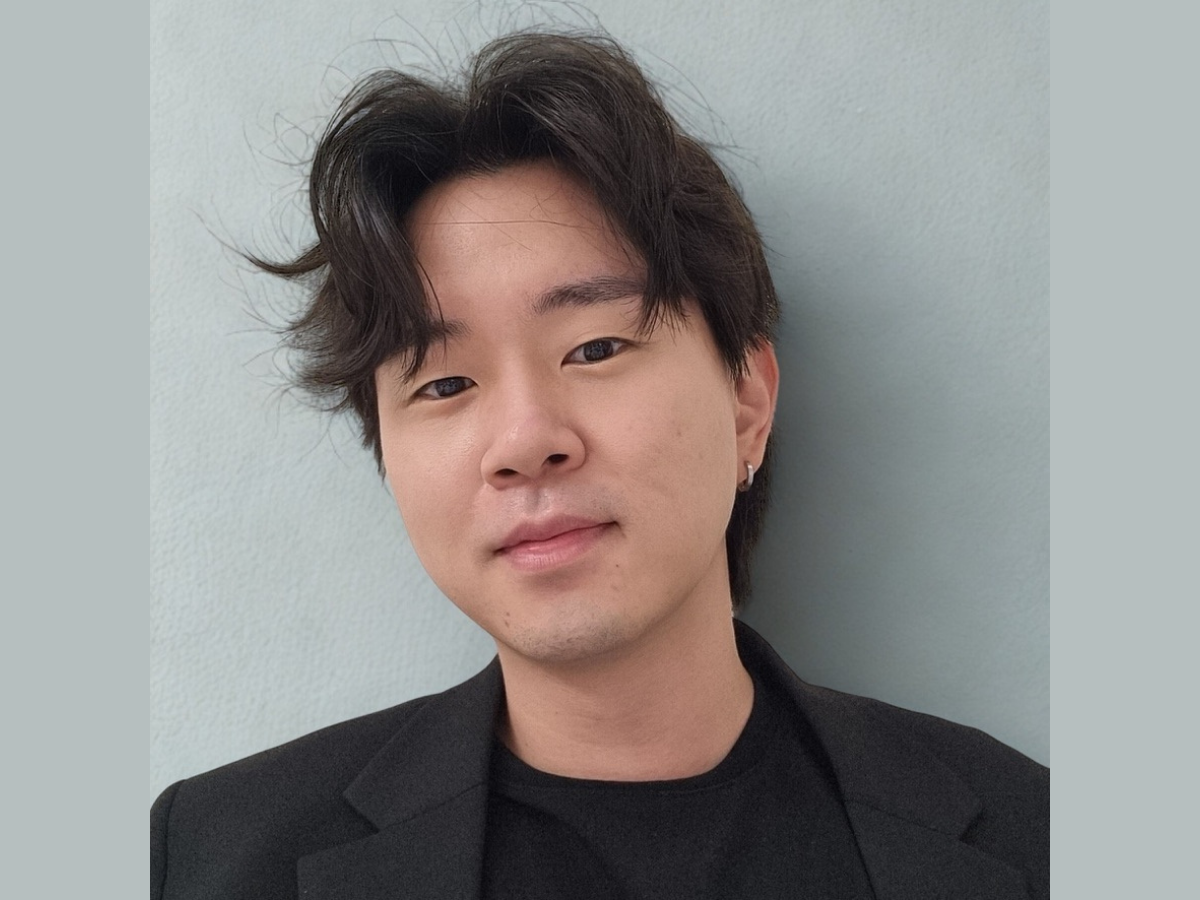
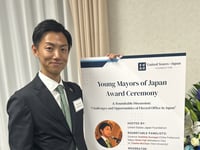 Hiroto Fujii, mayor of Minokamo City in Gifu Prefecture and inaugural recipient of the United States-Japan Foundation's Young Mayors Award, visited Dubuque, Iowa, from August 1 to 4, 2026, as part of the study visit to the United States supported by the award. Through wide-ranging exchanges with officials and community leaders working across areas of sustainable urban development, Mayor Fujii gained many insights to bring back to the governance of Minokamo City.
Why Dubuque?
Mayor Fujii's decision to visit Dubuque was rooted in the many parallels between the two cities. Their populations are comparable, approximately 59,000 in Dubuque and 57,000 in Minokamo, as are their total land areas, at roughly 83 km² and 75 km² respectively. Both cities also share a history of development shaped by a major river: the Mississippi and the Kiso. Beyond geography, Dubuque experienced a farm crisis in the early 1980s, which drove the highest unemployment rate in Iowa and led to the loss of roughly 10% of its population. Its subsequent recovery under a long-term policy vision made it a particularly instructive case for Minokamo, which faces shared challenges of population decline and industrial transformation.
"Sustainable Dubuque": A Coherent Policy Framework
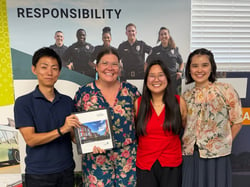 At the center of the visit was Dubuque's "Sustainable Dubuque" initiative, a policy framework the city has advanced for more than 20 years. Organized around principles including community design, smart energy use, resource management, a healthy local economy, green building, and healthy food, the framework has been maintained as a top policy priority across successive administrations and political transitions. This commitment has contributed to the city's receipt of the National Civic League's All-America City Award. The clear alignment between the framework's principles and the criteria governing the city's grant programs is something Mayor Fujii has identified as particularly applicable to Minokamo's own policymaking. (Photo: Sustainability Director Gina Bell, second from right, and other officials)
Bee Branch Watershed Flood Mitigation: Where Infrastructure Meets Civic Participation
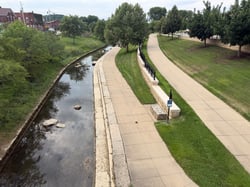 The visit to the Bee Branch Watershed flood mitigation program offered a close look at a major infrastructure effort that converted a formerly underground storm drain, which had repeatedly caused severe flooding in the surrounding area, into an open, creek-like channel and green space. The project involved the relocation of approximately 90 homes and was realized through a careful process of consensus-building via a citizen advisory committee. The system is designed to withstand a 500-year flood event. Dubuque's experience in building sustainable flood-control infrastructure while navigating significant topographical constraints offered many points of reference for Minokamo, which sits alongside the Kiso River.
Smart City: Integrating Digital Technology and Urban Policy
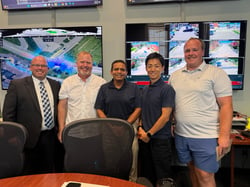 The delegation also examined the traffic management systems being developed under the "Smarter Sustainable Dubuque" STREETS program. These include a real-time traffic monitoring and anomaly detection system built on the city's extensive communications infrastructure, the expansion of pedestrian and cycling infrastructure to accommodate growing e-bike adoption, and the city's approach to managing downtown parking as a policy and urban development tool rather than a simple revenue source. Taken together, these initiatives offered an advanced example of integrating digital technology with urban policy. (Photo: Transportation Services Director Ryan Knuckey, far left, and other officials)
Connecting Children with Nature
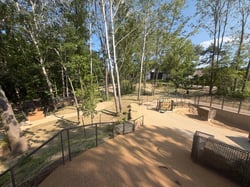 At Wonderwood Gardens, the delegation visited a facility on city-owned land planted primarily with native species, designed to give young children the freedom to move and engage with nature. The facility's emphasis on the role of unstructured outdoor experience in children's physical and cognitive development resonates with the direction Minokamo has been pursuing through its own satoyama (managed woodland) approach to community development. Mayor Fujii has also pointed to the city's community orchard program, which provides residents in food deserts with direct access to fresh fruit from trees planted on public land, as an initiative well worth drawing on going forward.
Community Foundation: Infrastructure for Civil Society
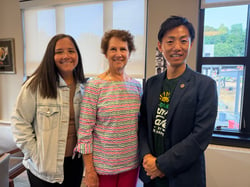 Mayor Fujii, who is also a First Year Delegate (2026, 2027) of the United States-Japan Leadership Program (USJLP), visited the Community Foundation of Greater Dubuque through the USJLP network. In Japan, supporting community organizations and managing public facilities remains largely the domain of government. By contrast, even in a regional city like Dubuque, a community foundation maintains a strong local presence and supports a wide range of activities. Mayor Fujii was particularly struck by the foundation's approach of placing as much weight on outcomes and data as on the passion behind a proposal, and of working to grow together with grantee partners through genuine dialogue. (Photo: President and CEO Nancy Van Milligen, second from left, and another official)
Observing a City Council Session: An Open Forum for Civic Participation
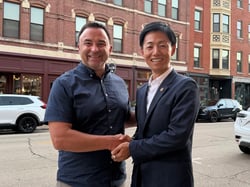 During his stay, Mayor Fujii also attended a session of the Dubuque City Council. The open format, in which residents come forward freely to raise proposals and questions, with the mayor and council members responding, at times voting on the spot and engaging speakers directly, reflects a system in which decisions and progress on city plans are made visible to the public in an open forum. This model of participatory democracy held clear relevance for Minokamo, where civic engagement and citizen involvement in local decision-making are central priorities. (Photo: Mayor Brad Cavanagh of Dubuque)
Reflecting on the Visit
Mayor Fujii offered the following reflections on the visit:
"Dubuque, a city of comparable scale and circumstances to Minokamo, and one that carries firsthand knowledge of rebuilding from decline, had much to teach us. The coherence of a policy framework maintained as a top priority across successive administrations, and the clear connection between its principles and actual budget decisions, are things I want to bring to bear on policymaking in Minokamo. The city's open approach to council sessions, where residents can come forward freely with their views and questions, is another model I hope to apply to our own work."
The Young Mayors Award was established by the United States-Japan Foundation in 2025 to recognize Japanese mayors under the age of 45 who demonstrate vision, integrity, and innovation in public service. Applications for the 2026 cycle open on Tuesday, September 1, 2026. For more information on the award, please visit https://www.us-jf.org/en/young-mayors-award. For inquiries, please contact the United States-Japan Foundation at info@us-jf.org.