Finding Each Other: Feminist Art, Translation, and the Work of Being Seen
March 13, 2026

Grantee | U.S.-Japan Feminist Art Network (Awarded in 2025 First Quarter)
Translation was everywhere. The choreography of interpreters moving between Japanese and English, the phrasing of questions designed to cross linguistic boundaries, as well as the broader and more delicate work of intercultural translation: translating experiences, identities, and political commitments into forms that could be shared without flattening their differences.
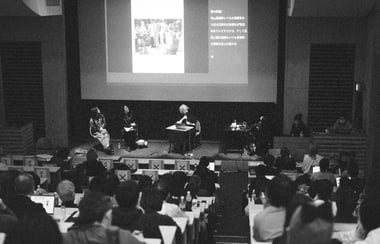 The room at Tokyo University of the Arts was full. The original proposal, “Contemporary Feminist Art: A Dialogue among U.S. and Japanese Scholars and Artists,” had turned into a hugely successful conference. Artists, scholars, students, activists, and members of the public listened closely, some hearing ideas about feminist and queer art and practice articulated publicly for the first time. What was happening in that space went beyond the exchange of information. It was an act of recognition. Art lawyer and art historian, Yayoi Shionoiri (USJLP 2010, 2011), one of the project’s core organizers, pointed out, “It is a sense of solidarity among and between communities.” The other organizers were activist and graphic designer Satoko Miyakoshi and art historian Emiko Inoue. Guest speakers included Sharon Hayes, Mai Endo, Ginga Kondo, Yoshiko Shimada, Skawennati, and Yui Usui.
That sense of solidarity marks the public emergence of a community network designed to sustain dialogue across borders, generations, and disciplines. Supported by the United States-Japan Foundation, the project grew out of a shared awareness that feminist artists and scholars in Japan and the United States were often grappling with similar questions, about representation, power, and social responsibility, without always having opportunities to encounter one another directly. (Photo credit: Hanae Takahashi)
When Naming Feminism Feels Risky
In Japan, openly identifying with feminism or even gender equality can still feel fraught. As Shionoiri noted in conversation, “In Japan, when one declares oneself as a feminist, the perception is often that one is angry, difficult, or disturbing the peace.” She added that many people, especially younger artists and younger members of the public, may agree deeply with feminist principles, “but they hesitate to identify that way because they don’t want to be seen as disrupting the social fabric.”
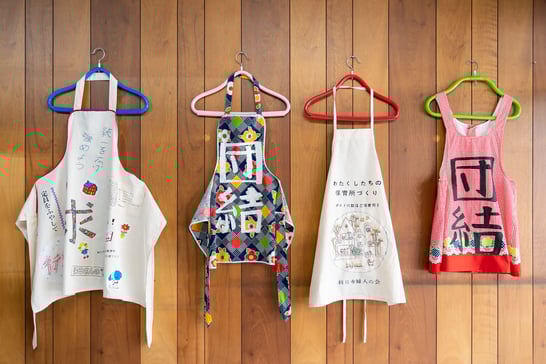
Yui Usui, Demands and Resistance (2019)
fabric, thread, hangers, screen print on fabric, building blocks, photos, bricks
Creative expression, however, offers another route. Through contemporary art, performance, writing, and art as a form of activism, questions of gender, identity, and justice can be raised obliquely, inviting reflection rather than demanding declaration. “I do think there are tactics and strategies where artistic practice and visual culture can help bring recognition to feminist identities and practices,” Shionoiri reflected.
She offered a concrete example that resonated strongly with participants on both sides of the Pacific. “In Japan, people sometimes declare their commitment to feminist ideals through fashion — a patch, a slogan, something they can take off if they need to — but that still matters. It’s a declaration to themselves.” The American participants learned that in a context where self-identification can feel risky, such gestures offer a flexible, personal way to identify and engage.
Art as a Language of Equality
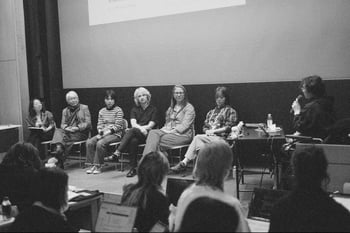 The symposium was designed to create space for precisely this kind of engagement. Rather than prescribing a single definition of art as activism, it brought together artists and scholars from Japan, the United States, and other territories to speak from their own positions, across generational and national boundaries. Several spoke candidly about their uncertainty: about whether their work was effective, or whether it reached the audiences they hoped to engage.
Shionoiri believes that that uncertainty, rather than weakening the discourse, became one of its strengths. “A lot of what came out of the symposium was this idea of failure,” Shionoiri said, “and the idea that it’s okay to fail and keep failing, but it’s important to keep trying.” The symposium and community network did not resolve these questions, but it legitimized them, allowing participants to identify the social, cultural, and political challenges they all face in their different ways, and to share different ways to grapple with them openly and collectively. (Photo credit: Hanae Takahashi)
From Community to Convening
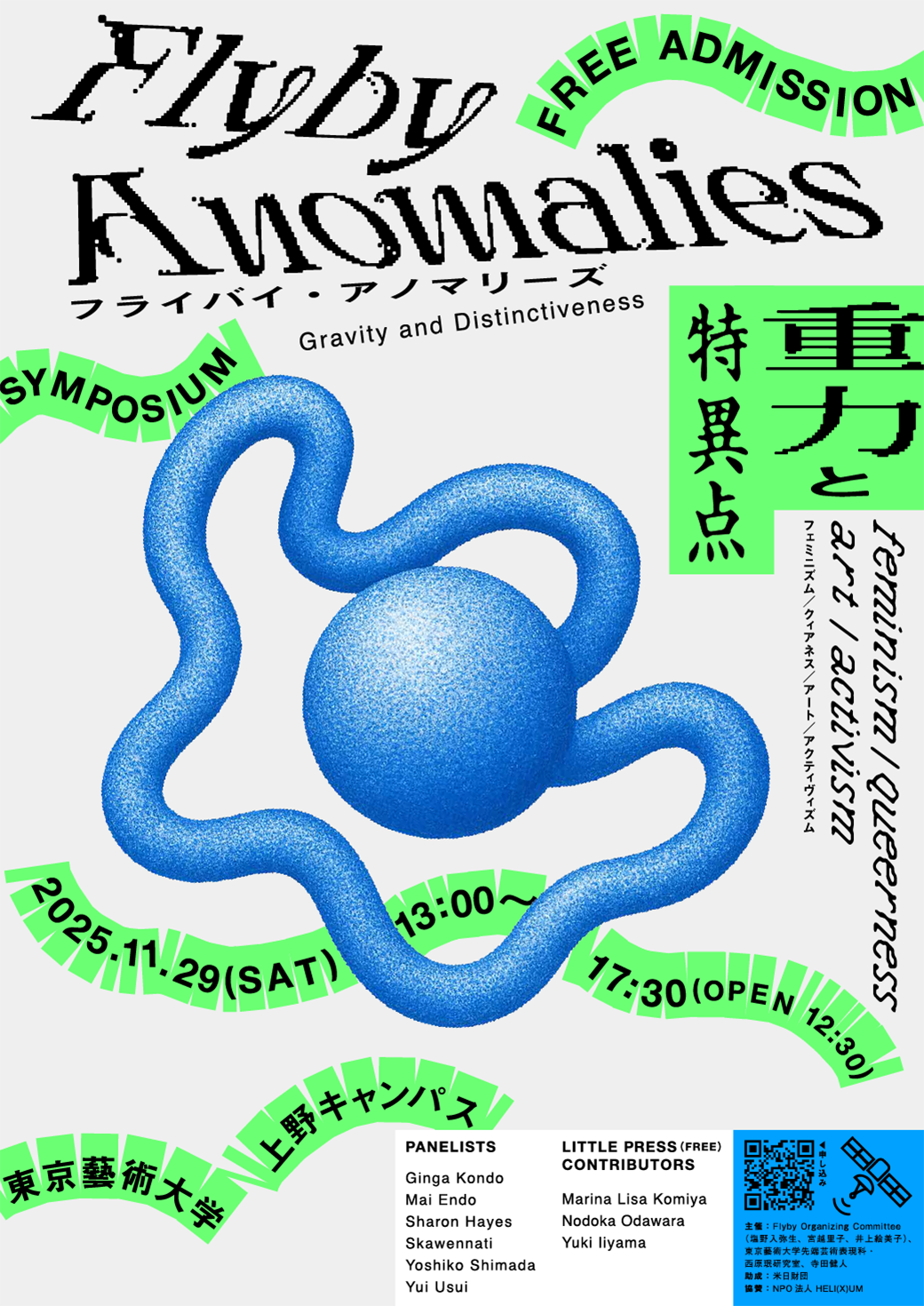 The roots of the project and community network trace back to the early years of the pandemic, when Shionoiri was in community with other feminist artists and thinkers in Japan and abroad. “During the pandemic, I was part of a volunteer benkyōkai, a kind of reading group, where feminist activists and artists in Japan and abroad came together,” she recalled. “We gave ourselves homework, read the same texts in Japanese and English, and talked. That was really the genesis of the network.” The symposium was the high point, at least so far.
From the beginning, the symposium organizers were committed to accessibility. The event was free and open to the public, fully bilingual, and supported by translators familiar with the language of contemporary art. A zine was created by the organizers, guest panelists, and additional contributors, including Yuki Iiyama, Marina Lisa Komiya, and Nodoka Odawara, and distributed to the attendees free of charge. The efforts to develop a shared language reflected a belief that feminist dialogue should not be limited to those already embedded in academic or activist institutions, but should remain porous and open, capable of welcoming those who arrive out of curiosity rather than prior affiliation.
Partnership and Support
Shionoiri’s role in shaping this vision reflects her own professional trajectory. Trained in art history and law, and working across nonprofit, artistic, and legal contexts, she has long operated as a bridging intermediary, attentive to how ideas move between systems. One of her jobs was to seek funding and support.
An important source of support was the United States-Japan Foundation, where Shionoiri was a Delegate in the US-Japan Leadership Program from 2010 and has been an active Fellow since. “USJF support was absolutely critical,” Shionoiri emphasized. "I think that USJF's funding influenced other institutions to also join in our efforts. It facilitated support from the Tokyo University of the Arts, our Japanese non-profit sponsor, HELI(X)UM, led by Japanese artist Sebastian Matsuda, and others." USJF’s financial backing enabled travel and coordination, but just as importantly, it signaled institutional confidence in the project. “Without USJF support, we would not have been able to do this at all,” she added.
Sustaining Cross-Border Exchange
From the outset, the symposium was imagined as a catalyst for ongoing and future actions. Participants have since begun discussing various collaborations, including co-authored articles, new convenings, and ways to remain connected beyond national boundaries. Digital preservation is a crucial part of this effort. Plans are underway to archive recordings and materials with The Feminist Institute, situating the symposium within a broader transnational history of feminist practice. At the same time, the organizers are careful not to over-formalize the community network. Rather than becoming a fixed institution, it is intended to remain flexible, capable of supporting new initiatives without dictating their direction.

Skawennati, Becoming Skywoman (2016)
machinimagraph from She Falls for Ages
What emerged most powerfully from the symposium was a sense of mutual visibility. For some participants, especially younger and LGBTQIA+-identifying attendees, simply being in a room where feminist and queer ideas could be discussed openly and safely was itself meaningful. Seeing others who shared similar questions, even if they approached them differently, offered reassurance that they were not alone.
In that sense, the community network is less about producing consensus than about sustaining connection. It does not ask participants to agree on a single strategy or ideology. Instead, it offers a place to return to: a framework within which dialogue, disagreement, and collaboration can continue to unfold.
In a context where naming feminism and queer theories can still feel risky, the community network demonstrates another way forward: not louder declarations, but shared spaces; not definitive answers, but ongoing conversation. Through the careful work of translation, across languages, cultures, and experiences, it helps make visible a community that has long existed, often just out of sight.
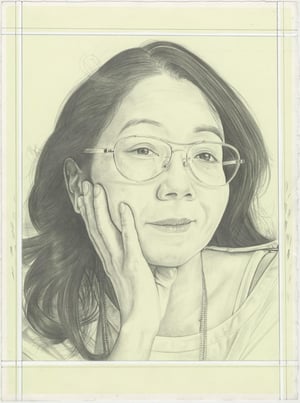
Portrait of Yayoi by Phong H. Bui