Mapping a Wonderful Ecosystem: How NAJAS Is Building the Infrastructure for U.S.-Japan Civil Society
January 26, 2026

Grantee | National Association of Japan-America Societies (Awarded in 2025 Third Quarter)
"I was lost in the blizzard of organizations—and I'd been doing this for thirty years."
Andrew Wylegala returned to Washington, D.C. after years working across Asia, expecting to slip back into the U.S.-Japan world with ease. His life had been shaped by Japan since high school: study abroad, graduate training, diplomatic service, years building people-to-people connections. But this time felt different.
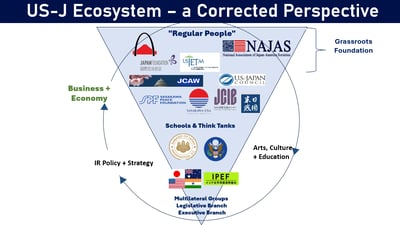
"There was this wonderful ecosystem," he recalls, "but I was lost in the blizzard of organizations." Even with decades of experience, he struggled to track who was doing what, where, and with whom. Events overlapped. Acronyms blurred. Opportunities for collaboration appeared only after they'd already passed.
Andrew had recently become president of the National Association of Japan-America Societies (NAJAS), a nearly 50-year-old organization representing 40 independent Japan-America societies across the United States and Canada. Supporting those members remained central to NAJAS's mission. But his early months raised a question: if insiders struggled to navigate the field, what did it look like from the outside?
The 99 Guide
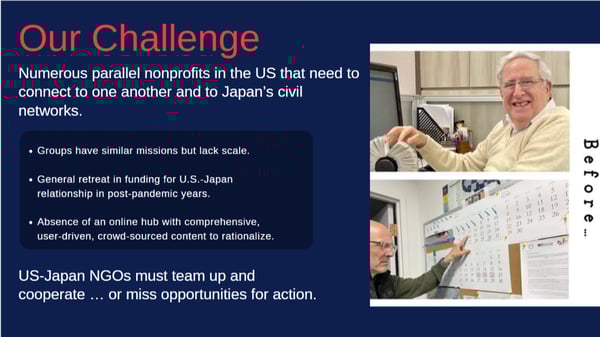
The response started small. NAJAS asked an intern to compile a directory of Japan-related organizations. The result became the NAJAS 99 Guide—a snapshot of key actors across the U.S.-Japan space. "We didn't actually know how many organizations there were," Andrew admits. "So we picked an arbitrary number."
The reaction surprised him. The guide circulated informally, but messages poured in from member societies, partner organizations, and individuals across the field. People thanked the team. They shared it with colleagues. They asked when it would be updated.
The response revealed something: a need for a shared reference point in a crowded ecosystem. But the limits were obvious. "After a year, it was already out of date," Andrew explains. "It wasn't keyword searchable. And it hadn't been fact-checked by the organizations themselves." The guide proved the concept, but static information couldn't keep pace with a living network.
Why Infrastructure Matters Now
The timing mattered. Over the past decade, interest in Japan has grown while nonprofits have faced tighter budgets, leaner staffing, and pressure to collaborate efficiently. COVID-19 accelerated these shifts, reshaping how organizations meet, fundraise, and sustain engagement. "In a business environment, you'd respond by consolidating," Andrew observes. "That doesn't happen in the nonprofit space. So the next best thing is to connect up better."
What the ecosystem needed wasn't another program, but shared infrastructure—the unglamorous capacity that reduces friction and makes collaboration easier. This became an inflection point for NAJAS. "For 47 years, we've been a member-service-based association," Andrew says. "But we saw the opportunity to be a platform for the broader people-to-people connection between the two countries."
Building the Hub
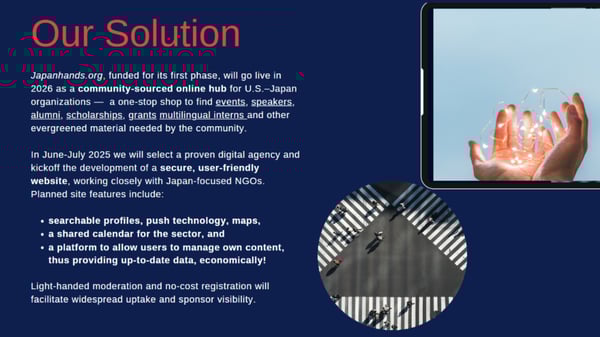
That shift took form in the NAJAS Hub: an interactive, bilingual online platform designed to serve the entire Japan-related ecosystem. Rather than replacing existing networks, it connects them—lowering barriers and improving visibility for newcomers and veterans alike.
Support from the United States-Japan Foundation proved decisive. "It was a game changer to have that support," Andrew says. While government actors expressed interest, public funding would have limited openness and flexibility. "To have that support from a private foundation enabled us to move forward—to start talking with IT vendors and people brighter than we are about architecture and sustainability."
The grant also sent a signal. USJF's investment showed confidence not just in NAJAS, but in the value of strengthening civil society infrastructure itself. "We wouldn't be having conversations with new partners if the U.S.-Japan Foundation hadn't opened the door," Andrew notes. Some of the documented progress to date can be seen in the report and video of the highlights from the 2025 NAJAS Network Conference.
The Calendar
 The Hub's first feature is deliberately simple: a shared calendar. The idea came from a recurring frustration. A university hosts a lecture by a prominent Japanese author. Across town, a Japan-America society schedules a similar event the same week. Neither knows the other exists. Speakers are duplicated. Audiences split. Opportunities vanish.
"Everyone wants to promote and market," Andrew says. "What better first step than getting the event on people's calendars?"
Organizations can maintain their own profiles and promote their own events, offering immediate value to the whole network while encouraging participation. The calendar serves as a gateway to future tools: searchable speaker, intern, and program alumni databases, ecosystem maps, and eventually databases for grants and scholarships.
What Success Looks Like
 Andrew measures success by adoption. "The calendar only works if scores of organizations are using it in the first six months."
Five years out, he imagines a different ecosystem. Newcomers orient themselves quickly. Smaller organizations punch above their weight because they're better connected. Japan-based organizations find U.S. partners without relying on personal introductions. Missed opportunities become rarer.
The Hub becomes genuinely transnational—shaped as much by Japan-based organizations as U.S. ones. That dimension is still under construction, but it's central to the project's ambition, and is a key reason NAJAS opted to partner with the American Friends of the International House of Japan and the International House of Japan on this project.
For USJF, supporting the Hub reflects a commitment to civil society itself: not just programs and events, but the connective infrastructure that allows relationships to endure. If successful, the Hub won't draw attention to itself. It will simply make collaboration easier—and help this wonderful ecosystem work as one. You too can learn more and support the Hub.
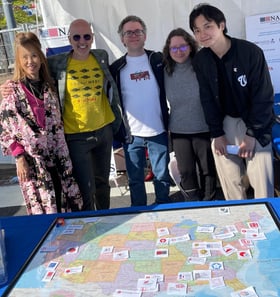
Image: Beyond Old School Mapping — staff and friends of NAJAS are pictured at last April’s Washington, D.C. Sakura Matsuri Street Festival, where they regularly appear to build community and scout for volunteers and interns.